


In the News
The explosive growth of AI and datacenters across
Appalachia’s energy economy is making headlines.
Cardinal sits at the intersection of this booming economic opportunity.
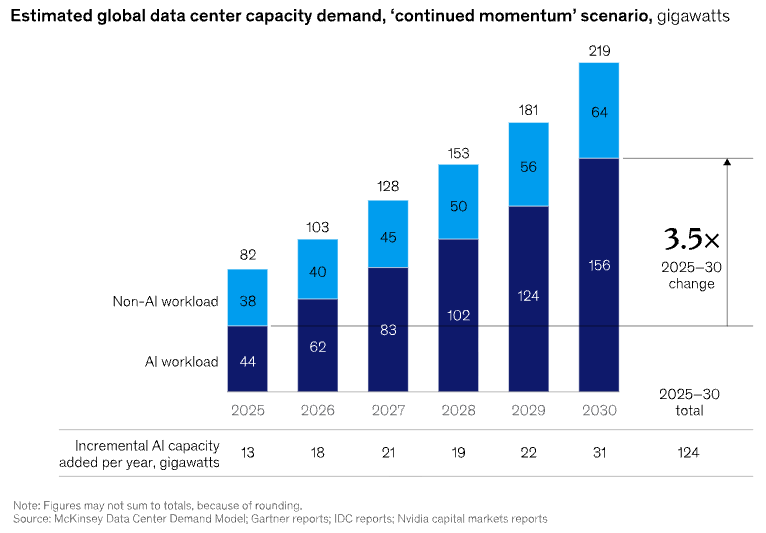
Recent reports and news stories paint a clear picture of a rapidly growing data center and AI ecosystem that is dramatically increasing electricity demand and reshaping energy infrastructure. Government and industry analyses show that data centers — especially those supporting artificial intelligence — are driving significant growth in power consumption, with electricity use in the sector projected to rise sharply both in the U.S. and globally as more AI workloads come online. This trend has policymakers and utilities in Kentucky and broader Appalachia planning major energy investments to meet anticipated demand while also introducing incentives to attract data center development for economic growth and job creation.
Barr touts coal-first energy agenda, says it’s key to Kentucky’s AI future
Republican U.S. Senate candidate Rep. Andy Barr unveiled his plan Monday to jumpstart Kentucky’s beleaguered coal industry by fostering artificial-intelligence infrastructure.
– January 7, 2026
Fortune Magazine: “AI’s endless thirst for power is driving a natural gas boom in Appalachia”
Natural gas has always been the overlooked little brother to crude oil that drives the fossil fuel industry dating back to the famed Drake Well in 1859 in Pennsylvania, which launched the U.S. oil and gas industry. – August 9, 2025
KU WUKY: KU and LG&E have 20 data center projects in the pipeline, and Kentucky lawmakers sound interested in attracting more
Kentucky lawmakers heard the economic case for inviting data centers into the state Thursday.
"We're working on 20 data center projects right now. And those 20 data center projects have 5.6 gigawatts of potential request for us just in our service territory," said John Bevington, Senior Director of Business and Economic Development with KU and LG&E. – August 14, 2025
Fortune: How the AI data center boom is breathing new life into transforming dirty, old coal plants
When the Homer City power plant—the largest coal-fired facility in Pennsylvania—shuttered in 2023, it marked the end of a dirty era for the coal plants that dominated America’s electric grid for over half a century. Now, in a whirlwind turnaround, many of them are being revived to fuel the AI era. – August 31, 2025
Transform Communities By Adaptive Reuse of Legacy Coal Infrastructure to Support AI Data Centers
The rise of artificial intelligence (AI) and the corresponding hyperscale data centers that support it present a challenge for the United States. Data centers intensify energy demand, strain power grids, and raise environmental concerns. - June 23, 2025
Fast Company: This old Pennsylvania coal town could get a reboot from AI
At its peak, the Homer City power plant employed hundreds of people and could deploy enough to power 2 million homes. – June 12, 2024
Goldman Sachs: AI to drive 165% increase in data center power demand by 2030
The explosion in interest in generative artificial intelligence has resulted in an arms race to develop the technology, which will require many high-density data centers as well as much more electricity to power them. – Feb 4, 2025
Energy.gov: DOE Releases New Report Evaluating Increase in Electricity Demand from Data Centers
Domestic Energy Usage from Data Centers Expected to Double or Triple by 2028, DOE Continues to Accelerate Development and Deployment of Solutions to Meet Growing Demand.
– December 20, 2024
During his keynote address at the Council for Geoscience (CGS) Summit, held at the Durban International Convention Centre from October 25 to 27, Minerals and Energy Minister Gwede Mantashe expressed his belief that coal could “reinvent itself”, given sufficient investment.
Mantashe cited the CGS’s lead role in the pilot carbon capture, utilisation and storage project in Leandra, Mpumalanga. The project, which is expected to become operational in early 2024, will test the feasibility of injecting between 10 000 t to 50 000 t of carbon dioxide a year, to a depth of at least 1 km. – October 25, 2022
Russia continues to press its allegation that Ukraine plans to use a so-called “dirty bomb” on its own territory, and says it will take it up with the United Nations. Ukrainian and Western officials have denounced the claim as a “pretext for aggression.”
Kyiv has requested a team from the U.N.’s watchdog agency to inspect its nuclear power facilities in order to disprove Moscow’s claims. A “dirty bomb” is made to contaminate a large area with radioactivity, making it harmful or uninhabitable for residents there, without using a nuclear explosion. Meanwhile, a Russian court denied WNBA star Brittney Griner’s appeal after the American athlete was convicted on drug charges earlier this year. – October 26, 2022
Southern African nation seeks funding partners for plant
Renewables to balance use of fossil fuel, energy minister says
Botswana is seeking to secure funding partners for a $2.5 billion plant to produce synthetic fuels from coal, a plan rekindled by the energy crisis playing out in Europe, according to its energy minister.
The southern African nation has for nearly a decade discussed tapping its extensive coal resources to produce fuels to displace costly imports. That would follow the example of neighbor South Africa, which developed coal-to-liquids technology through Sasol Ltd. Government efforts to realize the project have accelerated since Russia’s invasion of Ukraine. – October 24, 2022
Banks, funds financing coal even after climate pledges
Report finds $1.5 trillion of coal finance since start of 2019
The dirtiest fossil fuel is still raising trillions of dollars of funding, despite finance industry pledges to back net zero carbon targets by the middle of the century.
Commercial banks have channeled more than $1.5 trillion across the coal supply chain since the start of 2019, according to a report from German researcher Urgewald and its partners. The findings come just over three months after dozens of banks joined Mark Carney’s global alliance to achieve net-zero emissions from finance. – February 14, 2022